Cool Math Games for the Classroom: 16 Ideas That Make Practice Feel Like Play
Looking for more ways to bring math home? See our companion piece on cool math games to play at home.
What makes a great classroom math game?
Cool math games for the classroom do not have to mean elaborate setups or extra planning time. When a game keeps students moving through real math problems, it turns practice into something students want to do, without taking anything away from the learning goals a lesson is built around.
Fitting genuine math practice into a busy school day can feel like squeezing water from a stone, especially when attention starts to drift during a warm-up, a rotation, or the last few minutes before the bell. This guide breaks down 16 low-prep game ideas for warm-ups, whole-class moments, small-group centers, and independent practice, both offline and online, so there is an option ready no matter what the day looks like.
A cool math game is one that keeps students engaged while they are still doing real math work, not just clicking through for entertainment. The strongest classroom games share three traits: they are simple to set up, they flex across grade levels, and they stay connected to an actual skill, whether that is multiplication, fractions, or problem-solving. A game can look completely different from a worksheet and still be doing the same job.
Quick warm-ups and bell ringers
These are built for the first five minutes of class: fast to start, easy to reset, and light on prep.
- Around the world: one student stands behind a seated classmate, both answer a flashcard or projected problem, and the faster answer keeps them "traveling" to the next desk.
- Buzz: students count aloud around the room, substituting "buzz" for multiples of a chosen number (great for reviewing multiplication and division patterns).
- Dice fact race: in pairs, students roll two dice, solve the resulting fact (sum, product, or difference, depending on the unit), and race to fill a small answer grid first.
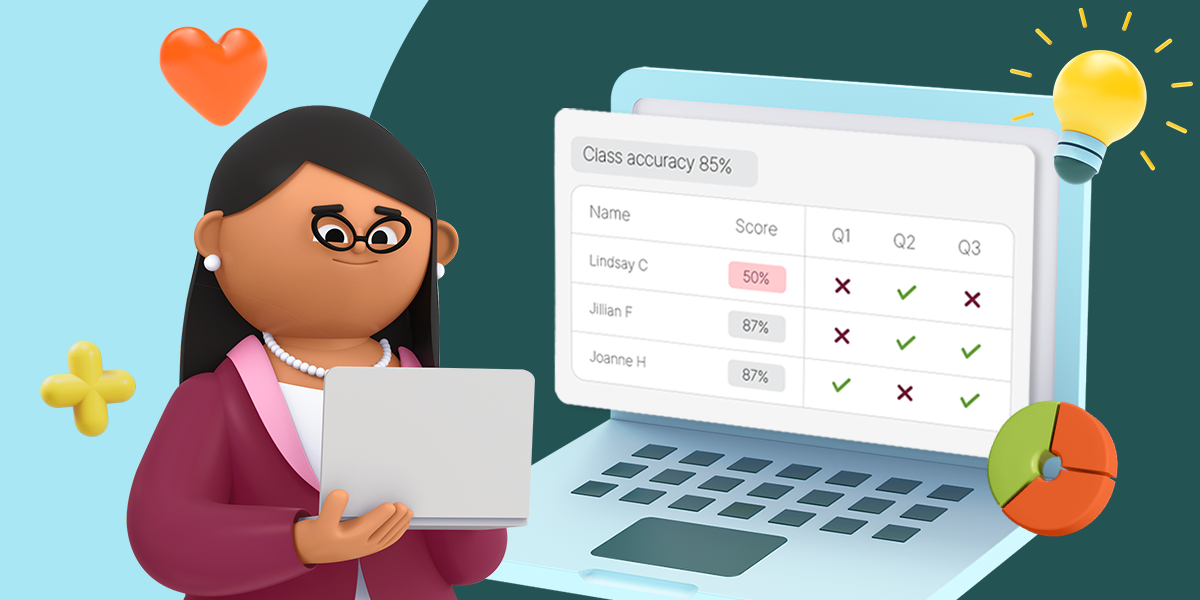
- Quick digital fact practice: a short, adaptive session in Math Facts by Prodigy gives every student a warm-up set at their own level, which is especially useful when a class has a wide range of fact fluency.
Whole-class games
These work well for review days, indoor recess, or any moment that calls for everyone participating at once.
- Four corners math: label each corner of the room with an answer choice, read a problem aloud, and have students move to the corner they believe is correct.
- Math trivia: a simple, teacher-built jeopardy-style board organized by unit or standard, played in table teams.
- Human number line: students holding number or fraction cards physically arrange themselves in order, which works especially well for comparing fractions or decimals.
- Silent relay: each row solves one step of a multi-step problem before silently passing it to the next student, building in accountability without a lot of talking.
Small-group and center games
Built for rotations, these need almost no supervision once students know the routine.
- Shut the box: a classic dice game where students "close" numbered tiles that match dice combinations, useful for addition fluency and mental math.
- Fraction or decimal bingo: call out a fraction, decimal, or percent, and students cover the equivalent value on their card.
- Task card scavenger hunt: post problem cards around the room, and have students solve and record answers as they rotate through in small groups.
- Math war: a deck of cards becomes a fast-paced comparison game (biggest product, biggest sum, biggest fraction) that partners can play with almost no setup.
Independent practice games
These give students something engaging to work through on their own, whether that is early finisher time, a rotation station, or homework.
- Adaptive digital practice: Prodigy World adjusts to each student's level as they play, so independent time stays productive even without direct supervision.
- Roleplay and arcade-style practice: in Prodigy World and Prodigy Arcadia, students answer math questions to progress through a story or unlock arcade-style challenges, which keeps motivation high during solo practice.
- Self-checking math mazes: students solve a problem, and the answer tells them which path to take next, so mistakes surface immediately.
- Roll and solve: a single die determines which problem set a student tackles next from a pre-made choice board.
Why game-based practice is worth the classroom time
The research on gamified math practice is genuinely mixed. Some studies find only a small boost to higher-order math skills, and others find that games hold their own against more traditional practice like flashcards without necessarily outperforming them. What shows up more consistently is the engagement piece: teachers describe games as a low-risk way for students to keep trying, since a wrong answer in a game does not carry the same weight it can on a worksheet. That lower-stakes repetition is often what turns a practiced skill into an automatic one.
Multiple studies have shown that when teachers integrate Prodigy into classroom instruction, student performance improves across key math standards.*
One teacher put it simply: "Prodigy has shown me the power of game-based learning, especially for students of this generation. Prodigy has them directly doing math, and doing arithmetic in order to power up." (Tonya Clark, teacher)
* Among multiple studies commissioned by Prodigy Education. Individual results may vary, results are not guaranteed.
Where Prodigy fits into a game-based classroom
Prodigy Math is a free, curriculum-aligned, game-based learning platform that supports students in grades 1–8. It is not a substitute for direct instruction, but a tool teachers can layer into the practice, differentiation, and engagement pieces of a lesson, whether that is a five-minute warm-up, a rotation station, or independent work time. Teachers can assign content tied to what the class is already learning and see how each student is doing along the way.
For more grade-spanning game ideas, see 27 exciting math games for kids or 22 fun math activities for your classroom.
Common Questions About Cool Math Games for the Classroom
Do math games need technology to work?
No. Many of the strongest classroom games, like dice games, card games, and human number lines, use no technology at all. Digital games are a nice addition when devices are available, but they are not a requirement for a game-based classroom.
How much class time should a math game take?
Most of the games above fit inside 5 to 15 minutes. Warm-ups and bell ringers are built to run in the first few minutes of class, while center and independent games can stretch to fill a longer rotation block.
Are math games appropriate across grade levels?
Yes, with small adjustments. A dice game like Shut the Box works for basic addition facts in early elementary and for larger sums in upper elementary, and a task card scavenger hunt can be built around any standard, from place value to ratios.
Can games replace regular math instruction?
No. Games work best as a companion to instruction, giving students extra, lower-pressure reps on a skill a teacher has already taught, not a replacement for teaching it.
Try free with a Prodigy teacher account.